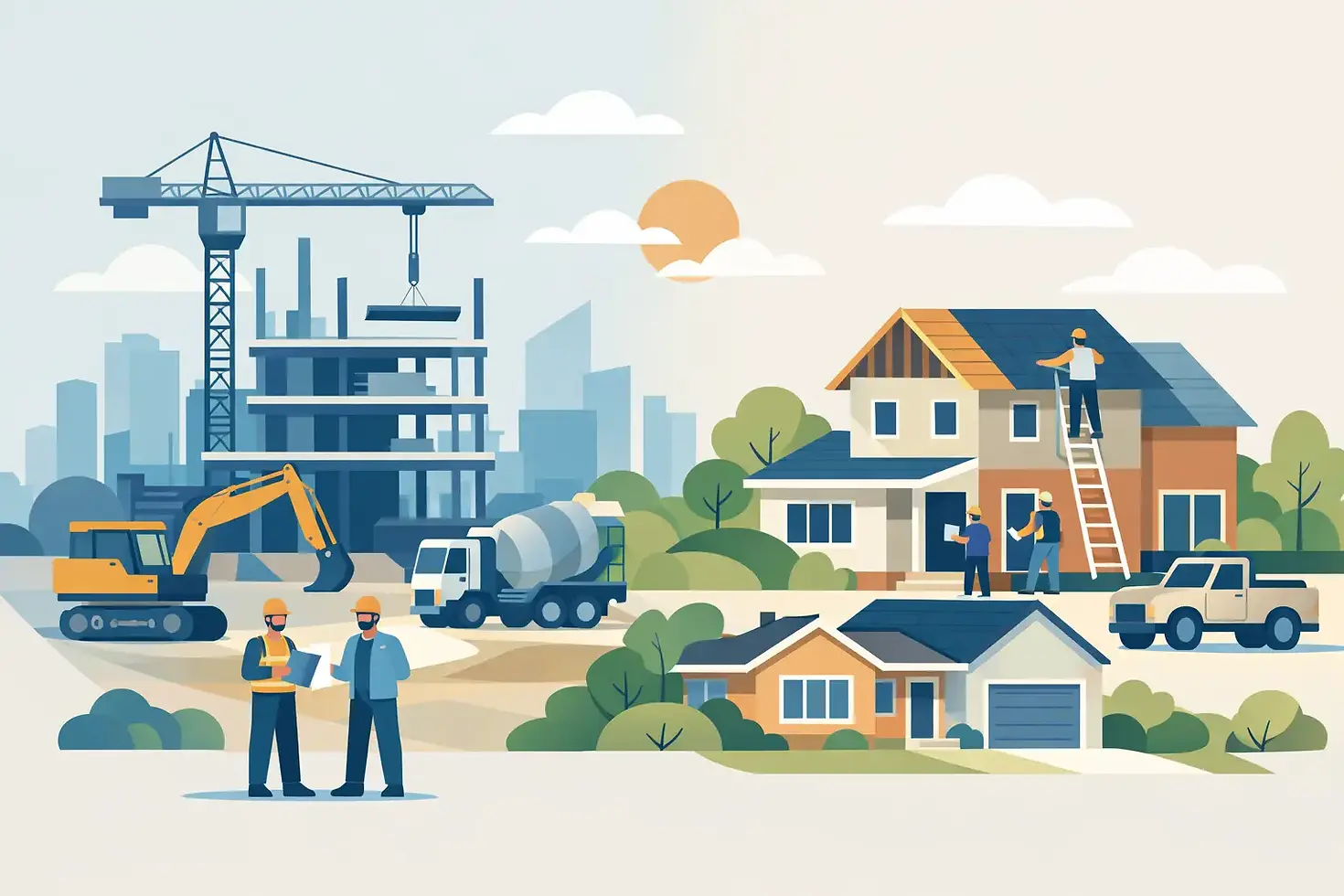
A building can look complete on day one and still underperform for decades. That is the real dividing line in commercial and residential construction services - not just whether a project gets finished, but whether it delivers lasting efficiency, durability, and control over the life of the asset.
For property owners, developers, and homeowners in Texas and Oklahoma, that distinction matters. Heat, humidity, operating costs, occupancy demands, and long-term maintenance all expose weak coordination between design and construction. When architecture, engineering decisions, and field execution move in different directions, the result is rarely visible right away. It shows up later in energy waste, envelope failures, comfort issues, scheduling friction, and expensive corrections.
What Strong Construction Services Actually Deliver
The most effective commercial and residential construction services are not defined by a broad service list alone. They are defined by how well each phase supports performance. A project should begin with clear design intent, carry that intent through estimating and planning, and arrive in the field with enough technical discipline to protect quality under real-world conditions.
That sounds straightforward, but many projects still move through fragmented teams. An architect develops the vision, consultants address technical systems, a contractor prices the drawings, and the owner becomes the party responsible for keeping everyone aligned. Sometimes that model works, especially on simpler scopes or with highly coordinated teams. But on complex, energy-conscious projects, the gaps between disciplines tend to become cost centers.
An integrated design-build model changes that equation. With one accountable partner guiding architectural design, construction, and project management, decisions can be evaluated for cost, constructability, efficiency, and long-term performance at the same time. That leads to fewer disconnects and a more disciplined path from concept to completion.
"From the first sketch to the final handshake, we provide a full suite of building solutions centered on high performance."
Visionary Building Services LLC
Why the Design-Build Model Changes Performance Outcomes
Owners often first notice the appeal of design-build in scheduling and communication. Those benefits are real. A unified team reduces handoff delays, limits finger-pointing, and creates a clearer line of accountability. But the larger advantage is technical alignment.
High-performance buildings depend on systems that work together. The building envelope, HVAC strategy, insulation, glazing, moisture control, ventilation, and structural details all influence each other. If those elements are designed in isolation, a project can meet minimum requirements while still missing its performance potential.
In commercial construction, this affects operating costs, occupant comfort, code compliance, and the lifespan of major systems. In residential construction, it affects indoor air quality, thermal stability, utility bills, and long-term maintenance exposure. In both cases, the project benefits when the same team evaluates trade-offs early instead of solving them after installation has begun.
Construction Services for High-Performance Buildings
Not every owner uses the phrase high-performance, but many are already pursuing it. They want lower operating costs, better resilience, fewer comfort complaints, and stronger long-term value. High-performance construction is simply the disciplined execution of those priorities.
Building Envelope
Walls, roofs, windows, air barriers, and insulation controlling heat transfer, air infiltration, and moisture movement in Texas and Oklahoma climates.
Mechanical Systems
HVAC evaluated as part of the full building strategy - not a separate package selected late in the process.
Envelope Precision
In demanding Texas and Oklahoma climates, envelope precision is central to durability and energy use, not a cosmetic issue.
Technical Depth
Teams with design-build expertise identify where upfront investment creates long-term returns and where economical solutions fit better.
Where Owners Gain the Most Value
Owners do not hire a construction partner just to manage trades. They hire one to reduce uncertainty and improve outcomes. In practice, that value tends to show up in four areas:
Clearer Budgeting
Budget clarity improves when design and construction input happen together. If a concept is unlikely to align with cost targets, the team can adjust before the documents are too far advanced.
Stronger Schedule Control
Schedule control improves because preconstruction and field planning are connected. Material lead times, sequencing constraints, site conditions, and permitting realities can be addressed early.
Better System Integration
Premium projects separate themselves through coordination with the precision required to support long-term efficiency and durability. When one team is responsible for both design intent and execution, the details receive more consistent oversight.
Fewer Post-Completion Surprises
The most expensive building problems are often not immediate failures. They are persistent underperformance issues that slowly erode value - and they decrease with integrated delivery.
Choosing the Right Partner
A construction firm should be evaluated on more than portfolio images and broad claims. Owners should look closely at delivery model, technical depth, and how the team defines success.
Experience is not just years in business. It is the ability to foresee conflicts before they reach the field, to understand how envelope and mechanical decisions affect long-term performance, and to manage execution without losing sight of the original design objective. On commercial projects, that may mean balancing occupancy demands, efficiency goals, and lifecycle costs. On residential projects, it may mean translating a custom vision into a durable, healthy, and energy-conscious home.
It is also worth asking how the firm approaches accountability. If problems arise, who owns the solution? In fragmented project structures, that answer can become unclear very quickly. In a true design-build relationship, responsibility stays with one integrated partner.
Building for Durability, Not Just Completion
The market does not lack contractors who can deliver a finished structure. What is harder to find is a team that treats each project as a long-term asset with measurable performance demands.
That mindset changes the entire process. It prioritizes design decisions that support operational efficiency. It treats material selection as a durability decision, not only a pricing exercise. It respects construction quality as a determinant of future maintenance, comfort, and system performance. And it recognizes that the owner's real return begins after the ribbon cutting.
Visionary Building Services LLC reflects that model through integrated design-build delivery shaped by 35 years of experience, with a clear focus on high-performance envelopes, mechanical systems, and long-term building value.
"Three decades of design-build mastery, utilizing carbonless materials and low-carbon methods for high-performance builds."
Powered by Carbonless methodology for low-carbon, high-performance buildings.